
A practical, step-by-step guide to making your business visible in both traditional search engines and the AI-powered platforms where your customers are increasingly finding their answers: Google SGE, ChatGPT, Perplexity, and beyond.
How to use this checklist: Work through each section in order. Earlier sections lay the foundation for everything that follows. Items marked AI have a direct impact on how AI-powered search engines discover and cite your content. Tick each box as you complete it and aim to cover at least the Foundation and High Priority sections before moving on to advanced tactics.
1. Technical Foundation
The infrastructure that makes your site readable by both crawlers and AI models.

1.1 – Ensure your site is fully crawlable
Check your robots.txt and XML sitemap. Confirm Google Search Console shows no critical crawl errors. AI crawlers (Googlebot, GPTBot, PerplexityBot) follow the same rules — don’t accidentally block them.
1.2 – Submit and maintain an up-to-date XML sitemap
Submit your sitemap to Google Search Console and Bing Webmaster Tools. Keep it dynamic so new content appears automatically. This accelerates discovery by both search engines and AI crawlers.
1.3 – Achieve Core Web Vitals passing scores
Target LCP under 2.5s, CLS under 0.1, and INP under 200ms. Use Google PageSpeed Insights to identify and fix issues. Fast, stable pages rank higher and provide better signals to AI models assessing content quality. Try to reach minimum result of 90-90-90-90 on Google Lighthouse.
1.4 – Verify full mobile responsiveness
Google uses mobile-first indexing: what the mobile crawler sees is what gets indexed. Test with Google’s Mobile-Friendly Test and fix any layout or usability issues.
1.5 – Implement HTTPS across your entire site
HTTPS is a confirmed ranking signal and a basic trust indicator. Ensure all pages redirect from HTTP to HTTPS and there are no mixed-content warnings in your browser console.
1.6 – Fix broken links and redirect chains
404 errors and long redirect chains waste crawl budget and signal poor site health. Use Screaming Frog or Ahrefs Site Audit to find and fix them. AI models trained on your content need clean, complete pages.
1.7 – Ensure clean, logical URL structure
URLs should be short, descriptive, and use hyphens (not underscores). Example: /services/seo-audit not /page?id=482. This helps both users and AI models understand your site architecture instantly. Use your primary keyword at the beginning of the URL.
2. Schema Markup & Structured Data
Speak the language AI models use to understand and cite your content.
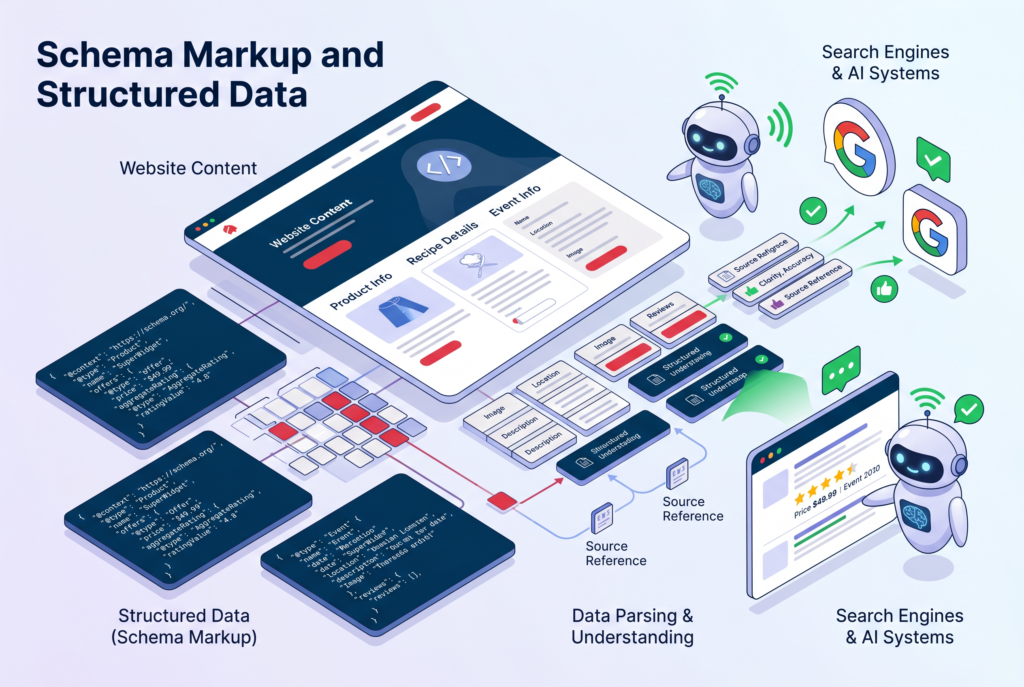
2.1 – Add the Organisation schema to your homepage
Include your business name, logo, URL, contact details, social profiles, and founding date. This is the primary signal AI systems like ChatGPT and Perplexity use to establish your brand’s identity and legitimacy.
2.2 – Implement Article / BlogPosting schema on all content pages
Include author, datePublished, dateModified, headline, and description. This helps AI models correctly attribute authorship and assess content freshness when generating answers.
2.3 – Add FAQ schema to pages with question-and-answer content
FAQ schema is one of the strongest signals for AI answer engines. Pages with clearly marked Q&A pairs are disproportionately cited in AI-generated summaries. Any page with “What is…” or “How to…” sections is a candidate.
2.4 – Add HowTo schema to instructional / step-by-step content
HowTo schema signals to AI models that your content provides procedural instructions. It increases the likelihood of your content being quoted or used as a source in AI-generated how-to answers.
2.5 – Add Person schema for key individuals
For authors, founders, or subject-matter experts, add Person schema with name, job title, social links, and associated organization. This builds the knowledge graph entity that AI models reference when citing experts.
2.6 – Validate all schemas using Google’s Rich Results Test or Schema.org
After implementation, run every key page through search.google.com/test/rich-results to confirm there are no errors. A broken schema provides no benefit and may cause confusion for AI crawlers.
3. On-Page SEO & Content Structure
Optimize individual pages so both users and AI models immediately grasp their purpose.
3.1 – Write unique, keyword-optimized title tags (50–60 characters)
Every page needs a distinct title tag that clearly describes the page’s topic and includes the primary keyword naturally. Avoid keyword stuffing — write for humans first, algorithms second.
3.2 – Write compelling meta descriptions (150–160 characters)
Meta descriptions don’t directly affect rankings but drive click-through rates from search results. Write them as mini-ads: include the primary benefit and a soft call to action.
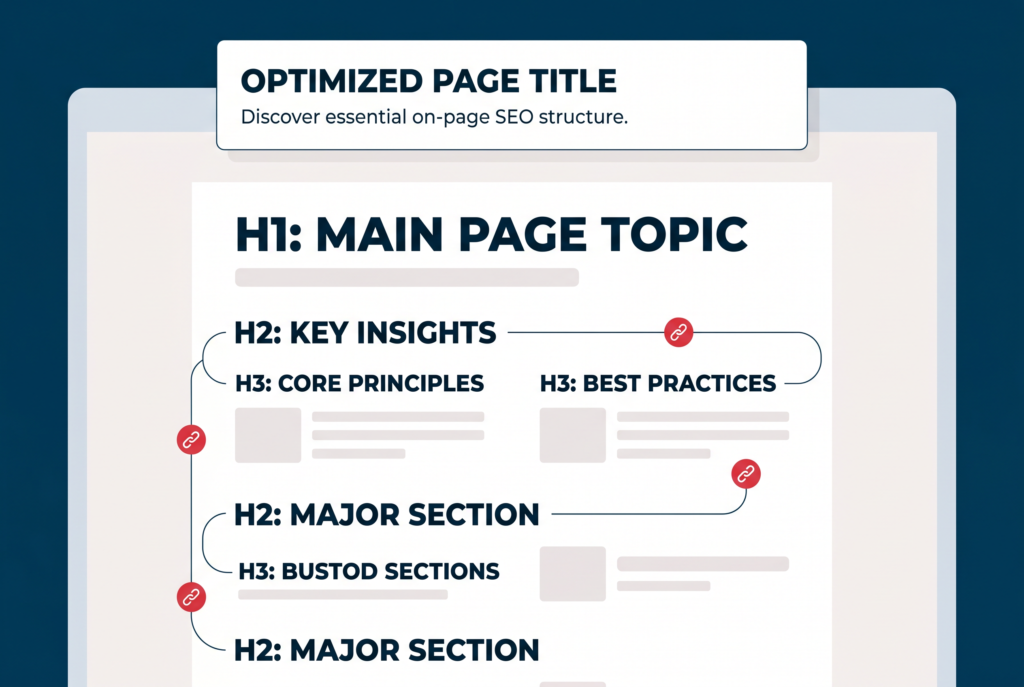
3.3 – Use a single H1 per page that matches search intent
Your H1 is one of the strongest on-page signals for both search engines and AI models. It should clearly state the page’s core topic and match the language your audience uses when searching.
3.4 – Use a logical heading hierarchy (H2 → H3 → H4)
A clear heading structure acts as a table of contents for AI models. When AI systems extract information from your page, they rely heavily on headings to understand the relationship between topics. Well-structured pages are cited more often.
3.5 – Write a direct, answer-first introduction
Open each article or service page with the core answer or key takeaway in the first 100 words. AI search engines often extract the opening paragraph as a featured answer. If you bury the answer, you lose the citation opportunity.
3.6 – Optimize images with descriptive alt text and compressed file sizes
Alt text helps search engines index image content and improves accessibility. Compress images to WebP or AVIF format to improve page speed. Descriptive filenames (seo-audit-checklist.webp) add another relevance signal.
3.7 – Build internal links between related pages
Internal linking distributes authority across your site and helps AI models map the relationships between your topics. Use descriptive anchor text that signals the topic of the destination page — avoid “click here.”
4. Content Quality & E-E-A-T
Demonstrate Experience, Expertise, Authoritativeness, and Trustworthiness — the signals AI models weight most heavily.
Add detailed author bios to all content
Every article should link to a rich author bio page listing credentials, experience, publications, and links to external profiles (LinkedIn, Google Scholar, etc.). AI models use authorship signals to assess how trustworthy a source is.
Include first-hand experience and original data in key content
Google’s E-E-A-T guidelines explicitly value real-world experience. Add case studies, client results, original research, or personal observations. AI models are trained to surface sources that contribute new information, not just restate existing content.
Cite reputable external sources within your content
Linking out to authoritative sources (.gov, .edu, respected industry publications) increases your content’s perceived trustworthiness. AI systems assess the quality of a page’s reference network as part of their credibility scoring.
Regularly update existing content for freshness
Update the dateModified schema and add a visible “Last updated” date when you revise content. AI search engines penalize stale information in fast-moving topics. A quarterly content audit is a minimum best practice.
Publish a clear About page and Contact page
Transparent business information is a key trust signal for both Google’s quality raters and AI systems. Include your full business name, physical location (if applicable), contact email, and a description of who you are and what you do.
Add clear terms, privacy policy, and disclaimer pages
For YMYL (Your Money or Your Life) topics — finance, health, legal — these pages are essential for maintaining high Quality Ratings. They also signal to AI models that your site is a legitimate, accountable source.
5. AI-Specific Optimization (GEO / AEO)
Tactics specifically designed to get your content cited in AI-generated answers.
Create dedicated FAQ pages and FAQ sections on key landing pages
Think like your customer: what are the 5–10 questions they type into ChatGPT or Perplexity before buying? Write those questions verbatim as H3 headings, followed by concise, accurate answers (50–100 words). This format is ideal for AI extraction.
Write content in a “definition + expansion” format
For any technical or industry term you cover, open with a one-sentence definition, then expand in subsequent paragraphs. This mirrors how AI models extract and present explanatory content. Example: “[Term] is [definition]. Here’s why it matters for your business…”
Target conversational, long-tail queries
AI search is conversational by nature. Identify phrases like “what is the best way to…”, “how do I…”, and “why does my business need…” using tools like AnswerThePublic, AlsoAsked, or Google’s “People Also Ask.” Create dedicated content for your highest-value queries.
Include statistical claims and data with source citations
AI models heavily favor content that includes verifiable data. Statements like “According to [Source], X% of businesses report Y…” are significantly more likely to be cited than unsourced claims. Make every stat traceable.
Optimize for featured snippets and “Position Zero”
Featured snippets (the boxed answers at the top of Google results) are a primary training source for AI models. Identify ranking pages where you’re in positions 2–10 and add a concise answer paragraph that directly answers the query in 40–60 words.
Check and adjust your AI crawler access settings
Review your robots.txt to confirm you are not accidentally blocking GPTBot, PerplexityBot, ClaudeBot, or Google-Extended. Blocking these crawlers prevents your content from being included in AI training data and real-time retrieval.
Build a concise, fact-rich “About” and brand entity page
Create (or optimize) a page that reads like a clean knowledge panel: who you are, what you do, key facts, founding year, notable clients or results, and links to your social profiles. This is what AI models read to build their understanding of your brand entity.
6. Topic Authority & Content Clusters
Build the depth and breadth of coverage that signals genuine expertise to AI models.
Identify your 3–5 core topic pillars
A topic pillar is a broad theme your business should own (e.g., “B2B Lead Generation,” “E-commerce SEO”). Define yours based on your services and ICP. All subsequent content planning flows from these pillars.
Create a comprehensive pillar page for each core topic
A pillar page is a long-form (2,000–4,000+ word) definitive guide on a broad topic. It links out to supporting cluster articles. AI models treat pillar pages as authoritative references for the topic — they are among the most frequently cited page types.
Build supporting cluster articles (8–12 per pillar)
Each cluster article covers a specific subtopic in depth and links back to the pillar page. This hub-and-spoke architecture signals topical depth to AI models, which are trained to prefer sources that comprehensively cover a subject rather than touching on it superficially.
Conduct a content gap analysis against competitors
Use tools like Ahrefs Content Gap or SEMrush Topic Research to identify topics your competitors rank for but you don’t. Prioritize gaps where your ICP has high search intent and where you can genuinely add value or a unique perspective.
Map your content to buyer journey stages
Ensure you have content for Awareness (educational), Consideration (comparison, how-to), and Decision (case studies, pricing, testimonials) stages. AI search users ask questions at all stages — without coverage at each level, you are invisible to segments of your audience.
7. Authority Building, Backlinks & Digital PR
Off-site signals that prove your credibility to search engines and AI models alike.
Audit your existing backlink profile
Use Ahrefs or Semrush to review your current backlinks. Identify toxic or spammy links worth disavowing, and spot patterns in what types of content attract links naturally. Understanding your baseline is the first step to improving it.
Pursue guest posts and thought leadership on industry publications
A bylined article on a respected industry site does three things: earns a high-quality backlink, builds your author entity in AI knowledge graphs, and increases the probability your name appears as a cited expert in AI-generated answers.
Get listed in relevant industry directories and resource pages
Niche directories (industry associations, vetted agency lists, review platforms like Clutch or G2) provide authoritative contextual links. These are also pages AI models frequently crawl when building topical reference maps.
Create original research, surveys, or data reports
Original data is the most powerful link magnet and one of the highest-value content formats for AI citations. Even a small survey of 50–100 customers can generate shareable statistics that other publications reference — and cite you as the source.
Build a Wikipedia or Wikidata entry (where eligible)
Wikipedia and Wikidata are primary knowledge sources for most AI models. If your company, founder, or product meets notability guidelines, a Wikipedia entry dramatically increases your presence in AI-generated knowledge graphs and entity recognition.
8. Local & Niche Visibility
Essential for businesses serving specific geographic or industry-defined audiences.
Claim and fully optimize your Google Business Profile
Complete every field: business category, description, hours, photos, services, and Q&A. Google Business Profile data feeds directly into Google’s AI-powered local answers (SGE). An incomplete profile means missed visibility in local AI searches.
Maintain consistent NAP (Name, Address, Phone) across all listings
Inconsistent business information across directories confuses AI models and signals poor data hygiene. Audit Yelp, Bing Places, Apple Maps, and relevant local/industry directories for accuracy. Tools like Moz Local can automate this at scale.
Actively generate and respond to reviews
Review volume and sentiment are major inputs into AI-generated local recommendations. A systematic post-service review request process (via email or SMS) is one of the highest-ROI local SEO investments. Always respond to both positive and negative reviews.
Create location-specific or industry-specific landing pages
If you serve multiple cities or industries, create dedicated pages for each (e.g., “/seo-services-helsinki” or “/marketing-for-ecommerce”). These pages capture hyper-specific search intent and appear in AI answers for location- or niche-qualified queries.
Need help implementing this checklist?
Ville Kauppi offers hands-on digital marketing and AI search optimization, from technical audits to full content strategy execution. No agency overhead, just results.
